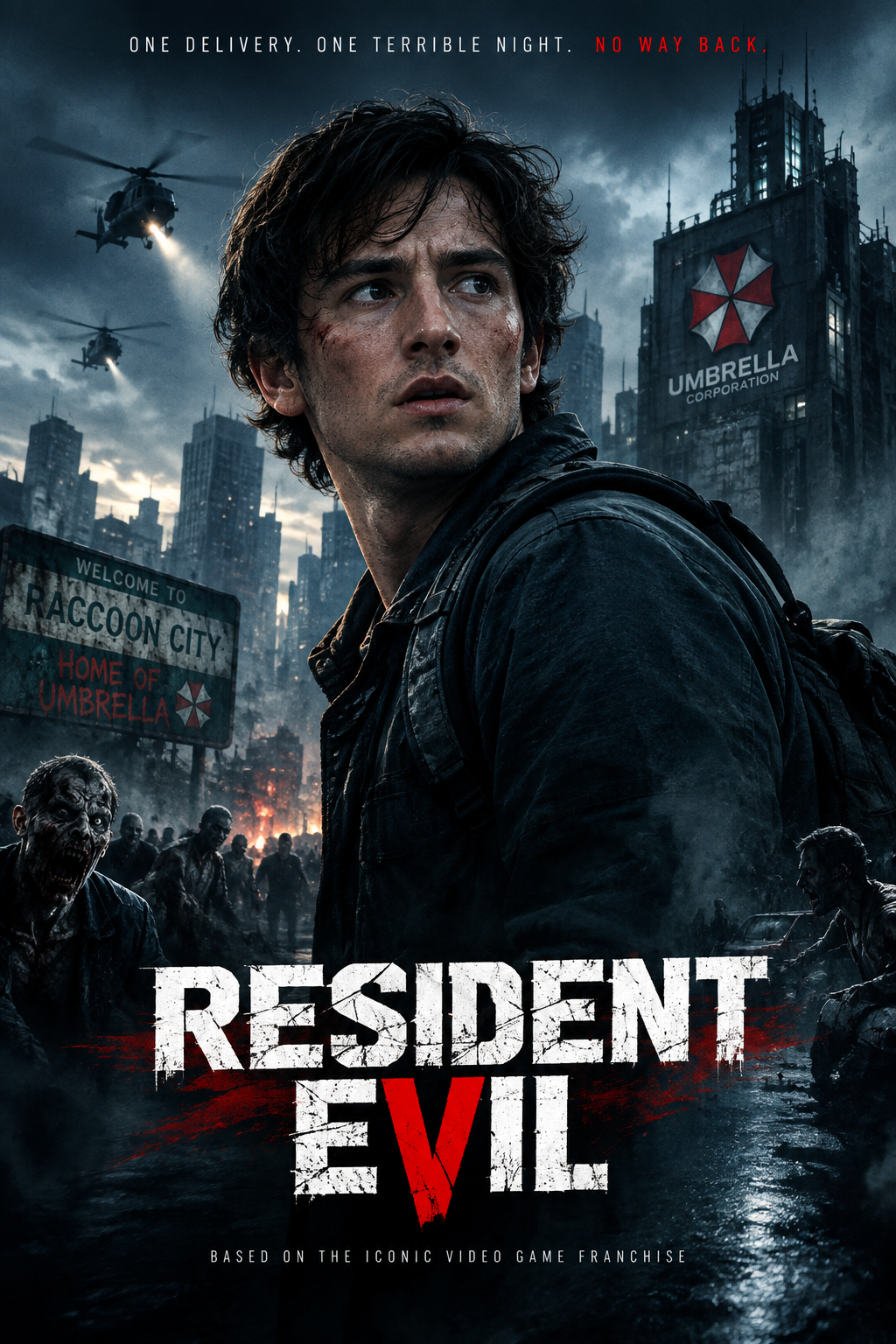
Resident Evil Review (2026): A Bloody, Fast-Paced Survival Horror Ride
1. Introduction
There is something refreshing about a Resident Evil movie that does not spend half its runtime explaining the entire history of Umbrella Corporation. Zach Cregger's 2026 reboot takes a much simpler route. Instead of bringing back familiar heroes from previous adaptations, it puts an ordinary medical courier named Bryan into the middle of a nightmare and lets the audience experience the chaos through him.
Played by Austin Abrams, Bryan begins the night with a job that sounds routine. He has to deliver a mysterious medical package to Raccoon City. What he does not know is that the city is already collapsing under an outbreak involving zombies, mutations and creatures that become increasingly difficult to understand or survive.
That basic setup gives Resident Evil a surprisingly personal quality. Bryan is not introduced as a super-soldier. He makes mistakes, gets frightened, improvises and sometimes survives situations more through determination than skill. That makes his journey easier to follow, especially for viewers who are not deeply familiar with the games.
Cregger also clearly understands what makes the games enjoyable. The movie uses exploration, limited resources, sudden monster encounters, environmental puzzles and changes in perspective to create the feeling of being inside a survival-horror game without simply copying one particular title.
The result is a compact horror-action movie that mixes genuine tension with strange humor and some extremely unpleasant creature imagery.
2. Quick Verdict
Resident Evil (2026) is a lean and energetic reboot that focuses more on the experience of surviving a nightmare than on expanding franchise mythology.
Austin Abrams gives Bryan enough personality to carry the movie, while Zach Cregger keeps the action moving through snowy streets, dark interiors, laboratories and increasingly grotesque encounters. The film's biggest strength is its ability to make a relatively simple story feel like a constantly changing survival challenge.
The movie is not equally strong in every area. Some supporting characters could have used more development, and the later action occasionally becomes so large that it loses some of the intimate tension found earlier.
Still, the combination of horror, dark comedy, creature effects and game-inspired filmmaking gives this version its own identity.
YoMovies2 Rating: 4/5
3. Movie Information
| Movie | Resident Evil |
|---|---|
| Release Year | 2026 |
| Release Date | September 18, 2026 |
| Director | Zach Cregger |
| Writers | Zach Cregger & Shay Hatten |
| Genre | Horror, Action, Thriller, Sci-Fi |
| Runtime | Approximately 90 minutes |
| Language | English |
| Country | United States |
| Certificate | R |
| Lead Actor | Austin Abrams |
| Main Character | Bryan |
4. Where to Watch Officially / Legally
Resident Evil (2026) was released theatrically on September 18, 2026. At the time of this review, the movie is officially playing in theaters, while a confirmed streaming release date has not been announced on Sony Pictures' official movie page.
For the latest legitimate availability, viewers should check their local cinema listings and the official Sony Pictures movie page rather than relying on unofficial streaming or download websites.
5. Story
Bryan is a medical courier who accepts a delivery that sends him toward Raccoon City. Under normal circumstances, it would simply be another job. Instead, he arrives at exactly the wrong place at exactly the wrong time.
The city is being overwhelmed by an outbreak. People are changing, creatures are appearing from places where they should not exist, and the normal rules of survival seem to disappear almost immediately.
Bryan's biggest advantage is not combat training. It is his ability to keep moving when everything around him tells him to stop.
The journey takes him through a series of increasingly dangerous locations. Each area introduces a different kind of threat, giving the movie the rhythm of a survival-horror game. One moment Bryan is trying to understand what is happening; the next he is running, hiding, shooting or desperately searching for a way forward.
There is also a personal story underneath all the horror. Bryan is dealing with an unexpected pregnancy involving his girlfriend, and his uncertainty about becoming a father becomes increasingly important as the night develops.
That subplot could easily have felt disconnected from the monster story, but the film gradually ties the two together. Bryan is not only trying to survive the outbreak. He is also confronting the possibility of a future he is not sure he is ready for.
The straightforward plot is intentional. Rather than stopping repeatedly to explain decades of franchise history, the film allows Bryan and the audience to discover the nightmare at almost the same pace.
6. Cast & Performances
Austin Abrams is the central reason the movie remains engaging. Bryan is not the traditional action hero who immediately knows what to do. Abrams plays him as an ordinary person whose confidence changes depending on the situation.
He can be funny without turning the movie into a comedy, frightened without becoming helpless, and determined without suddenly becoming superhuman. That balance gives Bryan an approachable quality.
Zach Cherry, Kali Reis and Paul Walter Hauser provide the supporting performances. Hauser in particular brings some eccentric energy to the film, helping the story shift between unsettling horror and dark humor.
The supporting characters are functional rather than deeply explored. The movie is much more interested in Bryan's journey than in giving every character a complete backstory.
That approach keeps the movie moving, although it also means some potentially interesting characters disappear before the audience gets much time with them.
7. Direction & Screenplay
Zach Cregger's direction is one of the movie's strongest elements. He does not treat Resident Evil as a conventional zombie-action blockbuster. Instead, he builds the movie around the feeling of being trapped inside an unpredictable game.
The screenplay by Cregger and Shay Hatten keeps the central objective easy to understand. Bryan has somewhere to go, something important to deliver and increasingly serious reasons to stay alive.
That simplicity is useful. The movie does not require the viewer to remember a complicated timeline or understand every piece of Resident Evil mythology before enjoying the story.
There are also several moments that clearly echo the mechanics of the games. Exploration, resource management, environmental obstacles and sudden creature encounters become part of the cinematic language.
The trade-off is that the story sometimes feels thinner than the filmmaking surrounding it. Viewers looking for extensive franchise mythology may find the approach unusually stripped down.
8. Cinematography
The visual design gives the movie much of its atmosphere.
Snow-covered roads, dark buildings, damaged vehicles, blood-covered rooms and industrial locations create a world that feels cold and unsafe. The movie frequently places Bryan in environments where the audience cannot immediately see what is waiting ahead.
The camera also borrows ideas from video-game perspectives. Certain sequences feel as though the audience is controlling Bryan rather than simply watching him.
The contrast between wide exterior landscapes and claustrophobic interiors works particularly well. A snowy city can look strangely beautiful one moment and completely terrifying the next.
The creature imagery is intentionally unpleasant. Mutations are not designed simply to look impressive; many of them are meant to make the viewer uncomfortable.
9. Music
The music and sound design play an important role in maintaining the atmosphere.
The film does not need a giant musical cue every time something frightening appears. In several scenes, environmental sounds and silence create more tension than a conventional horror soundtrack would.
The score by Ryan and Hays Holladay contributes to the strange combination of dread and momentum. Sound effects also give the creatures weight, particularly during close encounters.
The result is a soundtrack that supports both sides of the movie: the serious survival-horror material and the occasional dark comedy.
10. What Works
- Austin Abrams gives Bryan a believable personality.
- The survival-horror atmosphere remains strong throughout much of the movie.
- The creature designs provide variety instead of relying only on standard zombies.
- Game-inspired ideas are incorporated into the filmmaking without requiring viewers to know the games.
- The short runtime keeps the story moving.
- The balance between horror and dark humor gives the movie its own personality.
- The story is accessible to newcomers.
11. What Doesn't Work
- Several supporting characters receive limited development.
- The basic story may feel too simple for viewers expecting a large franchise mythology.
- Some later action sequences sacrifice the earlier feeling of vulnerability.
- The amount of gore will be uncomfortable for some viewers.
- The film leaves much of the wider Resident Evil universe unexplored.
12. Family Friendly
Resident Evil is not family-friendly.
The movie is rated R for strong bloody violence, gore and language. It contains zombies, mutations, graphic injuries and disturbing creature imagery. Younger viewers and people who are uncomfortable with graphic horror should avoid it.
13. Who Should Watch
This movie is aimed at viewers who enjoy survival horror, zombie films, creature features, dark comedy, video-game adaptations and fast-moving thrillers.
It is also suitable for newcomers to the franchise because the story introduces a new protagonist and does not require detailed knowledge of the previous live-action films.
Fans of the Resident Evil games may also appreciate the environmental puzzles, limited-resource feeling, camera choices and creature encounters that echo the experience of playing the games.
14. Who Should Skip
Viewers looking for a slow psychological horror film may find the movie too energetic and action-oriented.
It may also disappoint people expecting a direct continuation of the previous live-action Resident Evil movies or a story centered around established game characters.
Anyone uncomfortable with graphic gore, body horror or violent creature attacks should also approach this one carefully.
15. Pros & Cons
| Pros | Cons |
|---|---|
| Austin Abrams gives Bryan personality | Supporting characters are underdeveloped |
| Strong survival-horror atmosphere | Story is deliberately simple |
| Creative creature designs | Some later action loses the earlier tension |
| Good use of game-inspired visual language | Heavy gore won't suit every viewer |
| Short runtime keeps the story moving | Franchise mythology is relatively limited |
| Mixes horror and dark humor effectively | |
| Accessible to newcomers |
16. Rating Breakdown
| Category | Score |
|---|---|
| Story | 7.5/10 |
| Performances | 8.5/10 |
| Direction | 8.5/10 |
| Cinematography | 8/10 |
| Music & Sound | 8/10 |
| Horror | 8.5/10 |
| Entertainment | 8.5/10 |
| Overall | 8/10 |
YoMovies2 Final Rating: 4/5
17. ⚠️ Spoiler Warning
Warning: The following section contains major spoilers for Resident Evil (2026), including Bryan's infection, the antidote and the ending.
18. Ending Explained
Bryan's delivery becomes much more important than he initially understands. The package contains a component needed to complete an antidote for the outbreak.
The problem is that Bryan has already been infected after being bitten during his journey through Raccoon City. As he reaches the hospital, his condition continues to deteriorate.
The scientists begin working on the cure while Bryan's transformation becomes harder to stop. For a brief period, there is still hope that the antidote might save him.
That hope disappears during the final confrontation.
Bryan finally transforms into a monstrous biological weapon. His remaining human consciousness struggles against the creature taking control of his body, but the transformation wins.
The final confrontation results in the completed antidote falling from the hospital before Bryan can receive it. The scientists are killed, Bryan remains transformed and the opportunity to save him is effectively lost.
That ending is important because Bryan's story is not really about becoming a hero. He spends the entire movie trying to get home and survive long enough to deal with the future he was initially uncertain about.
His conversations about becoming a father give the final scenes an unexpectedly tragic meaning. By the time Bryan understands what matters to him, he has already lost the ability to return to his normal life.
The ending therefore works less as a conventional victory-or-defeat finale and more as a cruel consequence of the world he has entered.
The movie does not provide a traditional happy resolution for Bryan, and the final image leaves his future uncertain.
19. Final Verdict
Resident Evil (2026) is not trying to be the biggest Resident Evil story ever made. It is trying to make the audience feel what it would be like to suddenly find yourself inside one.
That decision gives the movie its strongest quality. Bryan is not a legendary franchise character. He is just a guy who accepts the wrong delivery on the worst possible night.
Austin Abrams carries that idea well. His performance gives the film an emotional center, while Cregger surrounds him with monsters, strange environments, sudden violence and moments of uncomfortable humor.
The movie's connection to the games is also more about experience than direct adaptation. Exploration, resource pressure, environmental puzzles, camera perspectives and escalating creature encounters make the film feel familiar to players without requiring it to retell a specific game.
There are weaknesses. The supporting characters do not always receive enough time, the story is intentionally straightforward and some of the later action becomes more chaotic than frightening.
But the movie knows exactly what kind of ride it wants to be.
YoMovies2 Rating: 4/5
Final Verdict: Resident Evil is a bloody, energetic and surprisingly human survival-horror reboot that finds its identity through Austin Abrams' performance, memorable creature work and a strong understanding of what makes the games exciting.
20. FAQs
Is Resident Evil (2026) a remake of the previous Resident Evil movies?
No. The 2026 movie is an all-new story and a reinvention of the franchise rather than a continuation of the previous live-action series.
Who plays Bryan in Resident Evil (2026)?
Austin Abrams plays Bryan, a medical courier who becomes trapped in Raccoon City during the outbreak.
Who directed Resident Evil (2026)?
Zach Cregger directed the movie and co-wrote the screenplay with Shay Hatten.
Is Resident Evil (2026) based on the games?
Yes. The film is based on Capcom's Resident Evil video-game franchise, but it tells an original story rather than directly adapting one specific game.
Do I need to watch the previous Resident Evil movies first?
No. The movie introduces a new protagonist and works as a standalone story, so previous knowledge of the live-action films is not required.
Is Resident Evil (2026) scary?
It contains horror, gore, zombies, mutated creatures and violent survival sequences. The film also mixes dark humor into its horror, so it is not completely serious from beginning to end.
Is Resident Evil (2026) suitable for children?
No. The film is rated R for strong bloody violence, gore and language.
What happens to Bryan at the end?
Bryan becomes fully infected and transforms into a monstrous creature. The antidote falls from the hospital before he can receive it, leaving his human fate unresolved.
Does Resident Evil (2026) have a post-credits scene?
Current reports indicate that the movie does not contain a traditional post-credits scene.
What is the YoMovies2 rating for Resident Evil (2026)?
4/5 (8/10)